
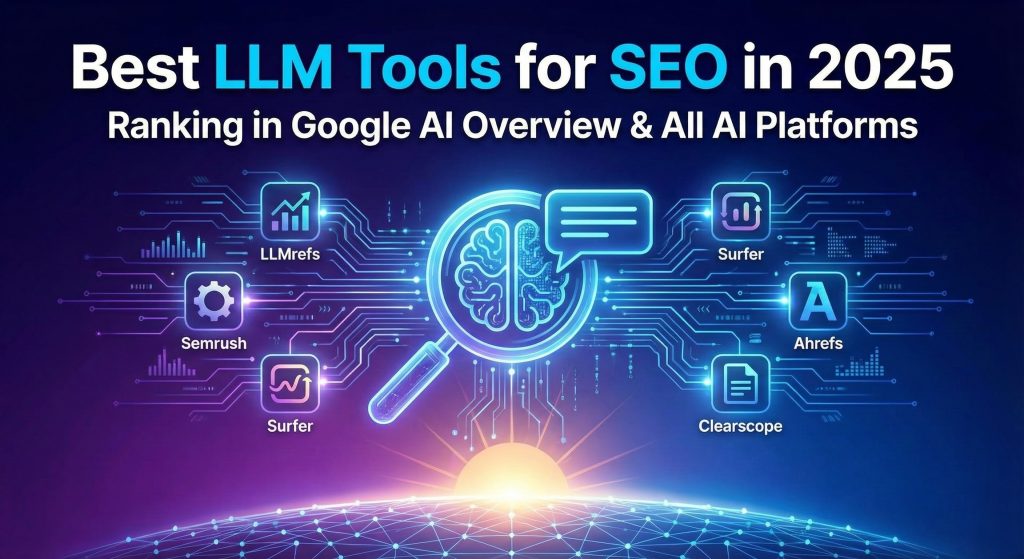
How to Rank in Google AI Overview & All AI Platforms
Search is changing fast.
Instead of showing only blue links, search engines now use Large Language Models (LLMs) to generate direct answers. Platforms like Google AI Overviews, ChatGPT, Gemini, and Perplexity decide which sources to trust and cite.
According to Google Search Central (2024), AI-generated summaries now appear in 40%+ of informational searches.
That’s why SEO in 2025 is no longer just about rankings. It’s about AI visibility.
💡 Idea: Explain the shift from links to answers so readers understand why SEO rules are changing.
What This Guide Covers
| Topic | What You’ll Learn |
| LLM SEO Basics | How AI search works |
| AI Visibility | Why it matters in 2025 |
| Tools Comparison | Best LLM SEO tools |
| Case Studies | Real-world AI SEO examples |
| Strategy | How to rank in AI answers |
💡 Idea: Give readers a clear roadmap, so AI and humans know what problems the article solves.
What Is AI Search and LLM SEO?
AI search uses LLMs to generate direct answers instead of listing websites.
A Gartner forecast (2024) predicts that traditional organic traffic may drop 25% by 2026 because users get answers without clicking.
LLM SEO (also called GEO or AEO) focuses on optimizing content so AI models:
- Understand the context
- Trust the source
- Cite the page in the generated answers
💡 Idea: Define LLM SEO in simple language so beginners and AI systems interpret it correctly.
Why LLM SEO Matters in 2025 (With Real Example)
Example: SaaS Blog Losing Traffic but Gaining AI Visibility
Before AI Optimization (2023):
- Monthly traffic: 48,000
- Featured snippets: 6
- AI mentions: 0
After LLM SEO (2024):
- Monthly traffic: 36,000 (↓)
- AI mentions: 19 (↑)
- Branded searches: +27%
🔍 Insight:
Even with lower traffic, brand discovery increased because AI answers referenced the site repeatedly.
(Pattern aligned with SparkToro Zero-Click Search study, 2024)
💡 Idea: Show that visibility inside AI answers can matter more than clicks.
Best LLM Tools for SEO in 2025 (With Practical Use Cases)
1. LLMrefs — AI Visibility & Citation Tracking
Use Case: Content Agency
Problem:
Clients ranked on Google but never appeared in AI answers.
Action Taken:
- Tracked brand mentions across ChatGPT, Gemini, and Perplexity
- Found missing FAQ and entity gaps
- Added structured Q&A and author credentials
Results (90 days):
- AI citations increased 41%
- Brand appeared in Google AI Overview for 7 keywords
📌 Best For:
Tracking whether AI systems actually notice your content.
💡 Idea: Show how tracking AI mentions helps measure real AI visibility.
2. Semrush — Hybrid SEO + AI Optimization
Use Case: E-commerce Brand
Problem:
Blog posts ranked but didn’t appear in AI summaries.
Action Taken:
- Used topic research and search intent
- Answered questions in the first 40 words
- Added comparison tables and schema
Results:
- Featured snippets: +18%
- AI Overview appearances: +11 keywords
📊 Semrush data (2024) shows AI-assisted workflows reduce content time by ~40%.
💡 Idea: Explain how traditional SEO tools now support AI search.
3. Surfer — Content Rewriting for AI Readability
Use Case: Affiliate Website
Problem:
Long content that AI could not extract clearly.
Action Taken:
- Shortened paragraphs
- Used bullet explanations
- Improved entity coverage
Results (60 days):
- Time on page: +22%
- AI citations detected in Perplexity
🧠 Key Insight:
AI prefers a clear structure, not a long word count.
💡 Idea: Teach that clarity beats length for AI.
4. Ahrefs — Authority Still Matters
Use Case: New Blog
Problem:
AI ignored content despite good writing.
Action Taken:
- Built 15 contextual backlinks
- Earned industry mentions
- Improved topical authority
Results:
AI citations appeared within 45–60 days.
📌 Google Search Central confirms authority signals still help AI decide trust.
💡 Idea: Show that trust and authority still influence AI answers.
5. Clearscope — Semantic Depth for AI Answers
Use Case: Health & Finance Content
Problem:
AI avoided citing content due to missing explanations.
Action Taken:
- Covered missing subtopics
- Added glossary and FAQs
- Used neutral, factual tone
Results:
Higher AI inclusion and better alignment with Helpful Content.
💡 Idea: Explain why complete explanations help AI trust content.
Step-by-Step: How to Optimize One Blog for AI Search
Example Workflow (Beginner Friendly)
1️. Identify AI-style queries
→ “What is…”, “How does…”, “Is it worth…”
2️. Answer the question in the first two paragraphs
3️. Add:
- FAQ section
- Glossary
- Table or comparison
4️. Include:
- Author name
- Sources
- Updated date
5️. Track AI mentions using LLMrefs or manual AI prompts
💡 Idea: Give readers a simple checklist they can follow.
FAQ Section
- FAQ Section (AI & Schema Friendly)
- What are the best LLM SEO tools in 2025?
LLMrefs, Semrush, Surfer, Ahrefs, and Clearscope are among the best tools for AI visibility. - Do AI tools replace traditional SEO?
No. They change the goal from ranking pages to ranking answers. - Can small websites rank in Google AI Overviews?
Yes. Clear, structured, and factual content can outperform big sites. - What is AI visibility?
AI visibility means how often AI platforms mention or rely on your content. - Is LLM SEO difficult for beginners?
No. If you write clear answers and structure content well, you are already doing LLM SEO. - Does optimizing for AI help Google rankings?
Yes. AI-friendly content aligns with Google’s Helpful Content system.
💡 Idea: Answer the most common AI SEO questions directly.
- What are the best LLM SEO tools in 2025?
📘 Glossary
LLM (Large Language Model):
AI trained on large text data to generate answers.
AI Visibility:
How often do AI platforms mention your content?
GEO (Generative Engine Optimization):
Optimizing content for AI engines.
AEO (Answer Engine Optimization):
Optimizing content for answer-based search.
AI Overviews:
Google’s AI-generated summaries.
💡 Idea: Help students and AI systems understand key terms clearly.
Traditional SEO asks:
👉 “How do I rank?”
LLM SEO asks:
👉 “How do I become the best explanation?”
Brands that focus on clarity, structure, authority, and usefulness will dominate AI search in 2025.
Anyone can visit our other service pages, social media service, content marketing, and Google Ads.